

Investors, brokers, litigators, lenders, and appraisers all rely on the income approach for most commercial real estate. Any asset capable of generating lease income can typically support an income approach analysis. Excluding special-use asset classes in rural, heavily owner-occupied markets, the income approach typically receives strong consideration from both appraisers and investors.
The income approach requires analysis of several core components:
- Market rent
- Rent structure (this example assumes a triple net lease)
- Market vacancy and collection loss
- Operating expenses for the subject property
- An appropriate capitalization rate
Each of these variables must be determined to construct a complete income approach.
When a property is leased, the key question is whether the in-place rent reflects market rent or falls below or above it. Below-market rent lowers the risk profile of the property, since there is less risk of lease default, which typically warrants a lower capitalization rate. Investors often view this scenario as a value-add opportunity, with the potential to renew leases at higher rates and subsequently increase property value. However, raising rents increases the probability of non-renewals and can extend frictional vacancy, the vacancy period between successive leases. This creates a tradeoff: higher rents may support higher value, but the timing of that increase is often where investors and appraisers diverge. For example, a five-tenant retail center with lease terms ranging from three to ten years requires an opinion of value that accounts for the inability to increase rents during that period. As such, using only market rent to build a proforma income approach would be inappropriate.
Vacancy is a function of macroeconomic trends, local comparable competitive supply, and the subject property’s occupancy history. A property that has maintained above-market occupancy raises the question of whether contract rent is below market. Appraisers effectively conclude an average vacancy rate over a ten-year horizon based on these data trends. A property that has sustained 100% occupancy may therefore suggest that rents are too low, since a typical investor would factor in market vacancy and increase rents accordingly. Appraisers evaluate how the market would ultimately treat the subject property.
Expense analysis compares market comparable data against the property’s historical operating expenses. It is also worth checking whether the concluded value differs from the assessed tax value. A concluded value lower than the assessed value may warrant a property tax appeal, while a higher concluded value suggests the assessment could increase in the near future. Insurance is another line item worth benchmarking, since premiums can vary widely between policies for otherwise similar properties. When a property appears to be overpaying, expenses are typically concluded more in line with the market. The same principle applies to common area maintenance expense: a poorly maintained property may warrant a higher CAM expense conclusion to support the level of maintenance required to sustain market rents.
The capitalization rate is the most closely scrutinized variable in the income approach. Dividing net operating income by the capitalization rate produces value, a calculation that reflects the risk and return an investor or owner-user is willing to accept for that income stream. Capitalization rates can be derived through several methods, the most common of which include:
- Comparable sales, extracting capitalization rates from transactions at the time of sale
- Investor surveys, referencing published survey data for the relevant property type
- Band of investment, evaluating prevailing lending terms to derive an appropriate capitalization rate
Capitalization rates warrant careful consideration in any valuation. A Starbucks location backed by a corporate guarantee, for example, typically commands a lower capitalization rate than a comparable space leased to an independent coffee shop, reflecting the reduced risk associated with a stronger lease guarantee.
Once an income approach is complete, the resulting opinion of value should be tested against the sales comparison approach and, in some cases, the cost approach. An income approach value that falls below the cost approach conclusion may indicate that the cost to construct the subject property is not justified by achievable market rents, an unfavorable signal for the asset. Comparing the income approach conclusion against the sales comparison approach is typically the more common test: does the concluded value align with adjusted comparable sales in the market? Alignment between the two approaches suggests the opinion of value is well-supported.
Reversing the income approach offers an effective way to test the reasonableness of a concluded value. In one engagement, a client believed the concluded value should be significantly higher than the appraiser’s opinion. Reversing the math, starting with the client’s target value and holding the capitalization rate, expense, and vacancy rate conclusions constant, revealed the market rent that would be required to support that value. The client’s target value was $75 per square foot above the appraiser’s opinion, yet the reversed proforma showed that supporting this figure would require market rent 30% above comparable data, despite the client’s requested rent already being $8 per square foot below what the math demanded. This result raised a reasonable question: how could the client’s opinion of value be supportable? Testing the remaining variables showed that, for a triple net lease, sensitivity concentrates primarily in the capitalization rate, with a secondary effect from the vacancy rate conclusion. Working through the math in this manner demonstrates, with reasonable certainty, that a well-supported opinion of value can withstand scrutiny.
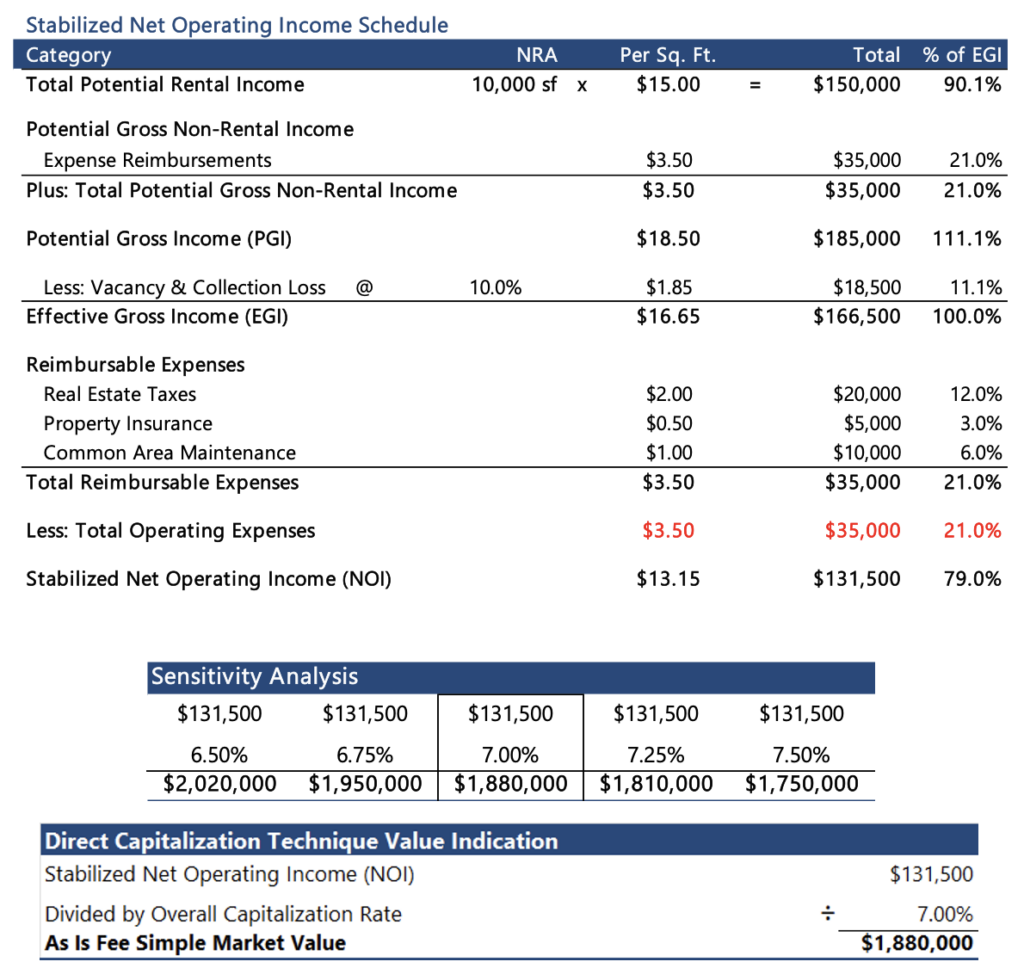
The example below illustrates a 7.0% capitalization rate, where each 25-basis-point decrease increases value by $70,000, or $7.00 per square foot. By comparison, reducing the vacancy rate from 10.0% to 9.0%, while holding the capitalization rate constant, increases value by $2.64 per square foot. In most cases, adjusting one variable warrants a corresponding review of the others to maintain an internally consistent proforma.
Knowledge is power, and math is proof. Appraisers who ground their valuation conclusions in rigorous, transparent math are best positioned to deliver well-supported opinions of value.
Chris Knight, MAI, R/W-AC, is Senior Managing Director for Valbridge Property Advisors and is based in Dallas-Fort Worth. He can be reached at c.knight@valbridge.com.
The information contained in this publication is for informational and educational purposes only. It is not financial, legal, or other professional advice, and you may not rely on it for any purpose. To secure professional advice for your particular situation, you must engage one or more appropriate professional advisors to advise you about your situation.
Related Services
Comprehensive Valuation and Advisory Services